
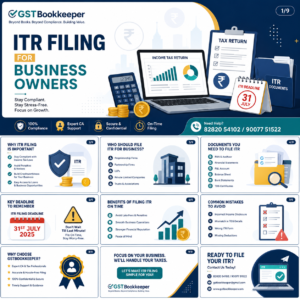
Running a business already means juggling suppliers, staff, cash flow, and customers — tax compliance often gets pushed to the last week. But ITR filing for business owners isn’t just an annual formality; it directly affects your ability to get loans, claim refunds, carry forward losses, and stay off the tax department’s radar. This guide breaks down everything a business owner needs to know about Income Tax Return for Business filing this year — the documents required, smart tax planning moves, and the mistakes that trip up even experienced filers.
Who Needs to File a Business ITR?
Any proprietorship, partnership firm, LLP, or company earning income from business or professional activity is required to file an Income Tax Return, regardless of profit or loss. This includes traders, manufacturers, distributors, consultants, and shop owners. Depending on your turnover and how your accounts are maintained, you’ll use ITR-3 (individuals/HUFs with business income under the regular scheme) or ITR-4 (presumptive taxation scheme under Sections 44AD/44ADA/44AE for eligible small businesses).
Key due dates for AY 2026-27 (FY 2025-26):
| Non-audit business/professional taxpayers (ITR-3/ITR-4), partners of non-audit firms | 31 August 2026 |
| Businesses requiring a tax audit | 31 October 2026 |
| Businesses with international/specified domestic transactions (transfer pricing) | 30 November 2026 |
| Belated return | 31 December 2026 |
Missing these deadlines attracts a late fee under Section 234F (up to ₹5,000) and blocks you from carrying forward business losses to future years — a benefit many owners underestimate until they actually need it.
Documents Required for Business ITR Filing
Good ITR documents preparation is 80% of a smooth filing experience. Keep these ready well before the deadline:
- PAN and Aadhaar of the proprietor/partners/directors
- Bank statements for all business accounts for the full financial year
- Books of accounts — ledgers, cash book, purchase and sales registers
- Profit & Loss Account and Balance Sheet (audited, if applicable)
- GST returns (GSTR-1, GSTR-3B, annual return) for reconciliation
- TDS certificates (Form 16A) and Form 26AS / AIS (Annual Information Statement)
- Invoices for major purchases, sales, and capital asset additions
- Loan statements and interest certificates, if the business has borrowings
- Depreciation schedule for fixed assets
- Tax audit report (Form 3CA/3CB and 3CD), where a tax audit is applicable
- Details of advance tax and self-assessment tax paid during the year
Reconciling GST turnover with the figures reported in the ITR is now closely scrutinised, so this step deserves extra attention rather than a last-minute glance.
Tax Planning Tips for Business Owners
Filing on time is only half the job — proactive tax planning through the year reduces your liability legally and keeps your books audit-ready.
1. Choose the right tax regime. Business owners can often choose between the old regime (with deductions) and the new regime (lower rates, fewer deductions). If you opt for the old regime, remember to file Form 10-IEA before the due date — missing this form can force you into the new regime by default.
2. Use presumptive taxation where eligible. If your turnover is within the prescribed limits, Sections 44AD and 44ADA let you declare a fixed percentage of turnover as profit, cutting down on detailed bookkeeping and audit requirements.
3. Claim all eligible business expenses. Rent, salaries, utility bills, transport, depreciation on machinery and vehicles, and interest on business loans are all deductible — many small business owners under-claim simply because expenses aren’t documented properly.
4. Plan advance tax payments. If your estimated tax liability exceeds ₹10,000 in a year, advance tax is mandatory in quarterly instalments. Paying late or underpaying attracts interest under Sections 234B and 234C.
5. Invest in tax-saving instruments strategically. Section 80C, 80D (health insurance), and business-specific deductions like Section 35 (R&D) or 80JJAA (employment generation) can meaningfully lower taxable income when planned ahead of the financial year-end rather than in the last quarter.
6. Reconcile TDS and GST data regularly, not just at filing time. Mismatches between your books, Form 26AS/AIS, and GST returns are one of the most common triggers for income tax notices.
Common Mistakes Business Owners Make While Filing ITR
Even well-run businesses slip up on Business ITR Filing. Watch out for these:
- Choosing the wrong ITR form — using ITR-4 despite exceeding presumptive scheme limits, or vice versa
- Not reconciling GST and books before filing, leading to mismatches that trigger scrutiny
- Ignoring Form 26AS/AIS and missing TDS credits, resulting in lower refunds or double taxation
- Skipping the tax audit when turnover crosses the prescribed threshold, inviting penalties
- Forgetting to e-verify the return within 30 days of submission — an unverified return is treated as not filed at all
- Under-reporting cash transactions or failing to maintain proper documentation for them
- Missing advance tax instalments, leading to avoidable interest costs
- Not carrying forward eligible losses because the original return was filed late
- Mixing personal and business expenses, which complicates both bookkeeping and deduction claims
- Waiting until the deadline to gather documents, leaving no time to fix discrepancies
Why Professional Tax Filing Services Help
Business tax rules change frequently — new due dates, revised forms, and updated reporting requirements are common each assessment year. Engaging reliable Tax Filing Services or a chartered accountant ensures your books, GST filings, and ITR stay consistent, your deductions are fully claimed, and your return is filed accurately the first time. For a growing business, the cost of professional help is usually far lower than the cost of a notice, penalty, or a missed refund.
Final Thoughts
ITR Filing For Business owners is more than a compliance checkbox — done right, it protects your working capital, strengthens your loan applications, and keeps your business audit-proof. Start gathering your documents early, plan your taxes through the year rather than at the deadline, and avoid the common mistakes outlined above. A little discipline now saves a lot of stress — and money — later.